
Real-Time Digital Twin.
A real-time digital twin mirrors your physical warehouse second by second — showing the live position of every forklift and pallet via ceiling-mounted AI cameras.
That live picture becomes your basis for full shopfloor transparency, data-driven optimization and what-if scenarios on real warehouse data.
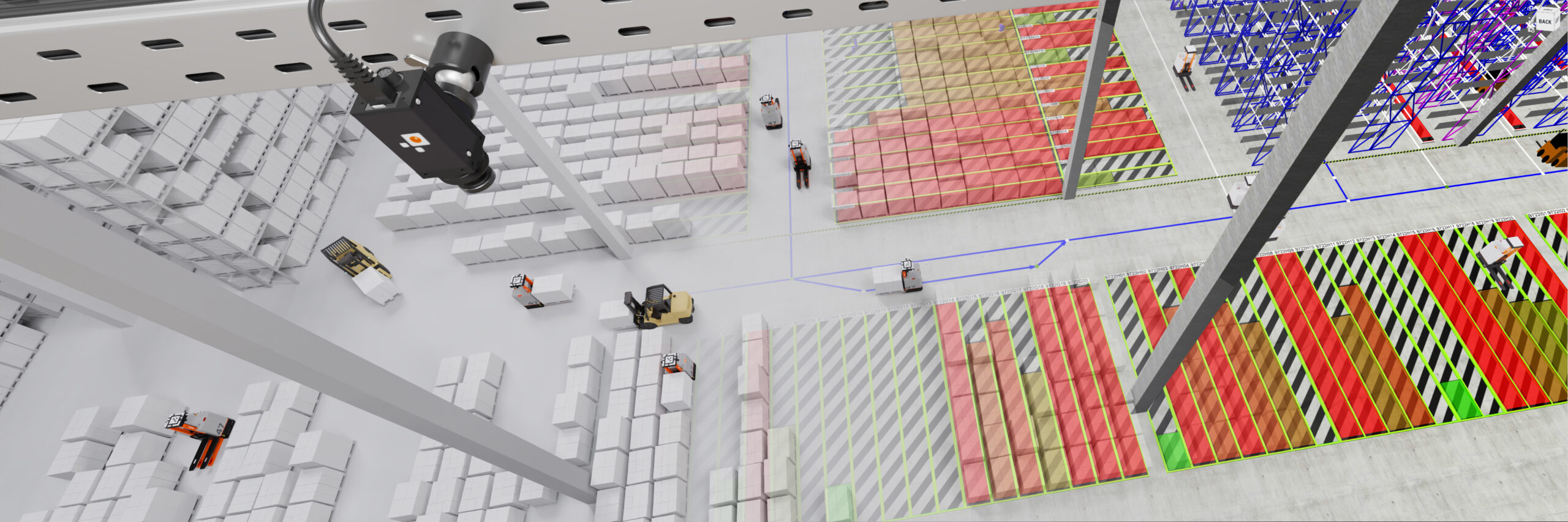
Full Shopfloor Transparency.
Gain real-time transparency over every movement, every vehicle and every storage location in your warehouse.
- Evaluation of the tracked data as heat maps or reports
- Evaluation of positions, speeds, idle times and productive times
- Determination of potential cost savings by reducing the number of vehicles, route optimization or improved storage
- (Optional) live camera view
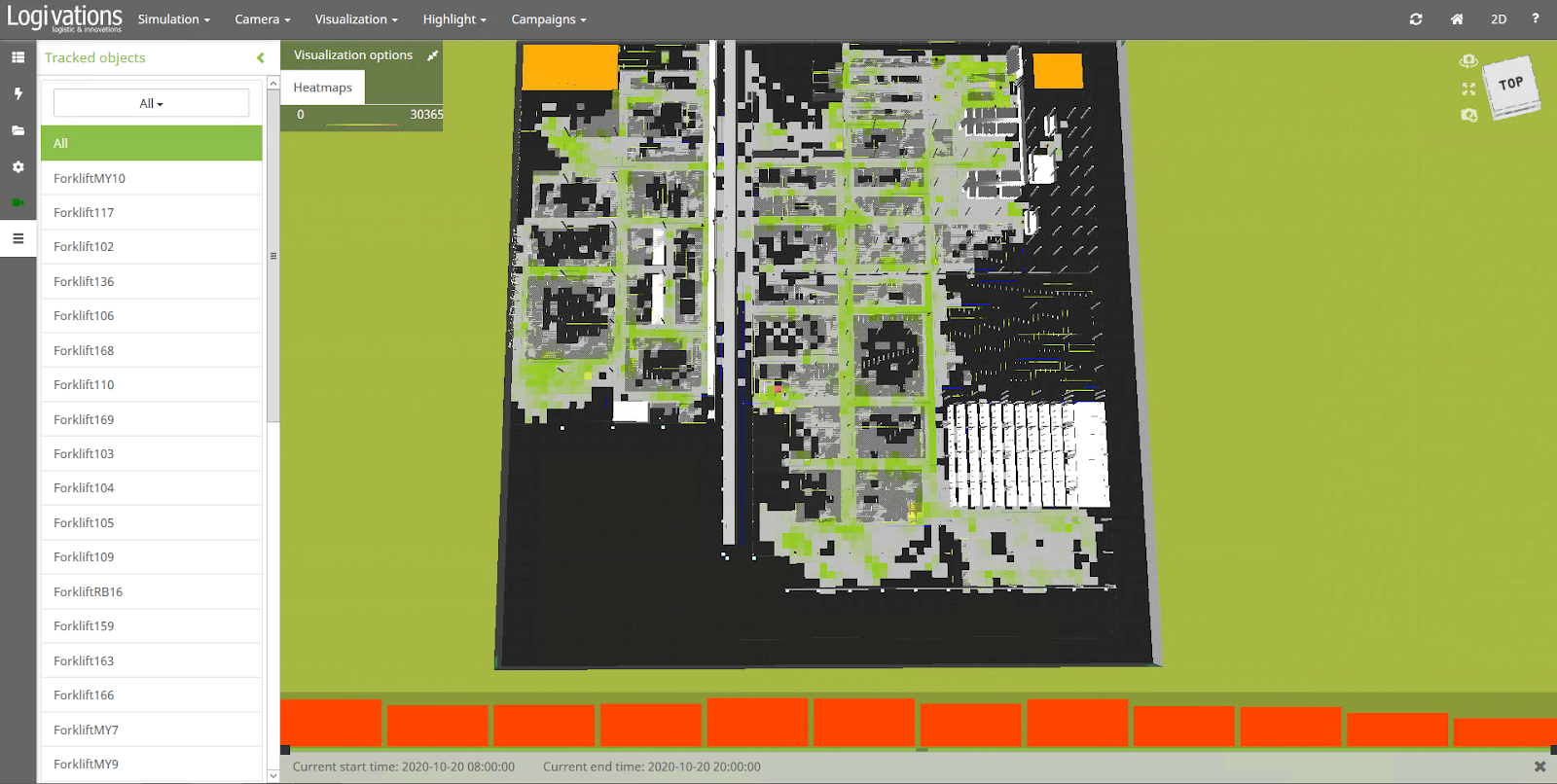
Our AI-RTL&RS tracks the movements of forklifts, persons, pallets, and other logistical entities. The tracked data is recorded in the Digital Twin, which makes it easy to evaluate the gathered data. Reports can be used to analyze idle time data and utilization rates. Heat maps show you the positions and speeds of forklifts and other vehicles directly projected onto the model of your warehouse. This makes it simple to take action based on the evaluation.
You can also opt for a live camera view, which gives warehouse control staff a clear view of what is going on in the warehouse, including person pixelation for the protection of personal rights.
Data source for optimization.
Tracking data becomes the foundation for the full set of W2MO optimization algorithms.
- Use tracking data as source for optimization
- Full scope of W2MO optimization algorithms are available
- Easy comparison of what-if scenarios on real data
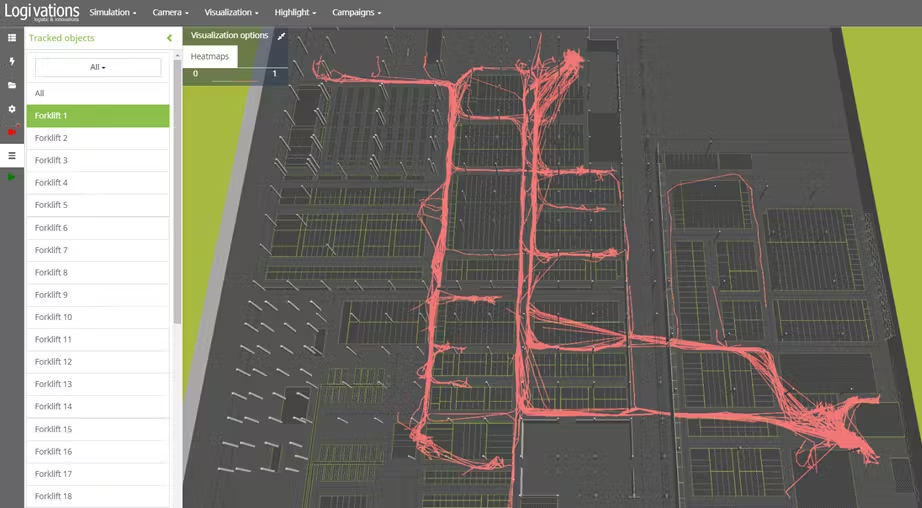
As all tracking data is saved to the W2MO Digital Twin, the multitude of optimization and evaluation algorithms provided by W2MO is only one click away. Without transferring data to a different tool, you can apply optimization algorithms like slotting, optimized tour building, or wave planning.
The real-time data allows the straightforward generation of what-if scenarios. These can be evaluated and compared using labor effort evaluations as well as bottleneck analysis.
Interested in our Real-Time Digital Twin?
Talk to one of our experts — no commitment.